विशेष लेख
Forest in paintings by famous artists
Forest landscapes are a popular theme in art, often favored by landscape painters. Immersed among trees, viewers feel transported to another realm, leaving behind everyday concerns. Forests can be portrayed in various ways: lush and green, glowing with autumn hues, or blanketed in snow. Some artists focus on sunlit clearings and gentle streams, while others emphasize the dark, mysterious undergrowth. Let’s explore how painters from different countries and artistic movements have approached forest imagery.
Aria Vale
लेखक
लेख परिचय
नीचे पूरा लेख पढ़ें।
अनुभाग
समाचार
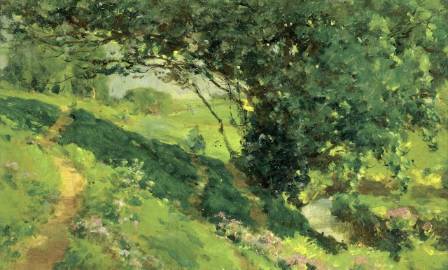
Forest landscapes are a popular theme in art, often favored by landscape painters. Immersed among trees, viewers feel transported to another realm, leaving behind everyday concerns. Forests can be portrayed in various ways: lush and green, glowing with autumn hues, or blanketed in snow. Some artists focus on sunlit clearings and gentle streams, while others emphasize the dark, mysterious undergrowth. Let’s explore how painters from different countries and artistic movements have approached forest imagery.
Forests in Dutch Art
In 17th-century Holland, forests became a common subject in painting. Individual trees had appeared earlier, but mainly as accents or backgrounds for narrative scenes. Dutch painters shifted attention to landscapes themselves, rendering them in meticulous detail and realism. Jacob van Ruisdael is the most celebrated landscape artist of the Dutch Golden Age, leaving behind numerous works that beautifully depict forest scenes.
Ruisdael’s forests often include subtle signs of human presence—a horse, a cart, or a small traveler dwarfed by towering trees. Occasionally, a dead or fallen tree appears in the foreground, symbolizing the fleeting nature of life and inevitable mortality.
Forest landscape with cows near a pond, 1782.
Other Dutch painters explored forests as well. Alexander Keirincx, for example, specialized in such subjects. Ruisdael’s work later influenced English landscape painters of the 18th and early 19th centuries, including Thomas Gainsborough and John Constable, the latter renowned for his depictions of the countryside.
The Barbizon School
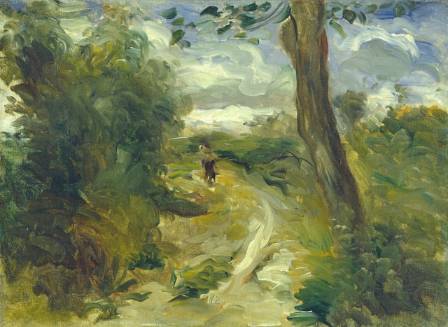
In the early 19th century, paint in portable tubes allowed artists to work outdoors. Painters of the Barbizon school took advantage of this, leaving studios to capture nature firsthand. Rejecting classical traditions that treated landscapes merely as backgrounds, and avoiding the embellished style of the Romantics, they spent extensive time in the Fontainebleau forest near the village of Barbizon, from which the school takes its name.
The Barbizon painters depicted nature realistically, appreciating its inherent beauty without embellishment. Théodore Rousseau, a key figure in the school, spent more time in the forest than anyone else, painting at different times of day and across seasons. Rousseau valued an old oak tree as highly as a Michelangelo sculpture. When industrialization threatened the forest, Rousseau and colleagues persuaded Napoleon III to protect the oldest sections, preserving the oaks from logging.
Henri Lebasque – Young Girl in the Forest, 1906.
At the same time, but independently, Camille Corot painted contemplative forest landscapes. His works often feature muted, monochromatic tones, yet subtle shifts in shade convey a reflective, melancholic mood.
Realism with Gustave Courbet
Corot was close to Gustave Courbet, a pivotal figure in 19th-century French art and the founder of realism. Courbet aimed to depict nature truthfully, without idealization, moving toward naturalism in his later landscapes. His oeuvre spans portraits, genre scenes, and social commentary, but his landscapes, especially forest scenes, demonstrate a vivid sense of life in French nature.
Road through the forest with a resting boy and dog, 1747.
Both the Barbizon school and Corot’s atmospheric landscapes influenced the Impressionists, who sought to capture fleeting moments on canvas. The forest offered an ideal subject, constantly shifting with light, weather, and perspective. Claude Monet, Camille Pissarro, and Alfred Sisley depicted forests with a focus on movement, color, and the ephemeral quality of nature.
Post-Impressionist Perspectives
Post-Impressionists, notably Vincent van Gogh, introduced their own vision of nature. Van Gogh loved the vibrancy and variation of the natural world, painting soaring cypresses, sprawling olive groves, and forested areas in his signature style with striking color contrasts. He also produced softer works that echoed Impressionist sensibilities.
Clearing in a pine forest, 1883.
Paul Cézanne also prioritized nature in his work. While he painted alongside Pissarro, his approach differed: Pissarro emphasized fleeting impressions filled with light and air, while Cézanne sought to reveal the underlying structure and permanence of nature. His forest compositions often explore perspective and eschew straight lines to express the essence of his observations.
Forests in Russian Painting
Russian landscape painters skillfully rendered forest scenes. Ivan Shishkin’s “Morning in a Pine Forest” remains iconic, showcasing his meticulous attention to every tree, bush, and blade of grass. Pines, birches, oaks, and ferns are depicted with both accuracy and reverence for nature. Forests also appear in the works of other Russian masters, including the Itinerants and Isaac Levitan.
Forest landscapes captured sunlight and shadow with the same care as European counterparts. Hubert von Herkomer painted rabbits within forested glades, while Shishkin portrayed structures like gatehouses tucked among dense woods. Wassily Kandinsky depicted the forest edge in 1903, and other Russian artists like Eugene Cicery explored forest paths, mills, and pinewoods, emphasizing both realism and mood.
Claude Monet at the forest’s edge. Painting by J.S. Sargent, 1895.
These examples illustrate the enduring appeal of forest landscapes across cultures and centuries, from meticulous realism to expressive, impressionistic approaches, demonstrating the forest’s timeless ability to inspire, shelter, and evoke reflection.
यह भी पढ़ें
The Benefits of Outdoor Play: Why It's Essential
Cybill

हाथियों के बारे में शीर्ष 10 तथ्य
आद्या
सफेद कपड़े कैसे पहनें?
राघव

4 बुनियादी बैडमिंटन कौशल जिन्होंने मेरे खेल को बेहतर बनाया
ओम

Top 10 Spindrift Sparkling Water Flavors Ranked From Worst To Best
Spencer Whitlock
अनंत नीले के साथ एक गोता यात्रा
टीगन केन