विशेष लेख
Real-Life 'Mecha' Robot
The recent introduction of Unitree’s GD01 “Mecha” robot—a piloted, transformable machine capable of switching between bipedal and quadrupedal modes—has captured public imagination, hinting at a future where robotic systems are not only practical but impressively formidable.
Stella Morgan
लेखक
लेख परिचय
नीचे पूरा लेख पढ़ें।
अनुभाग
समाचार
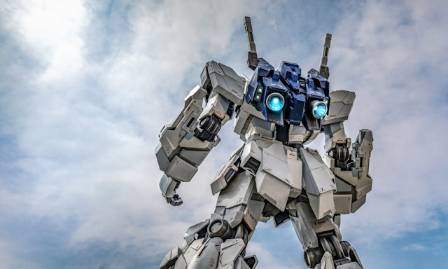
The recent introduction of Unitree’s GD01 “Mecha” robot—a piloted, transformable machine capable of switching between bipedal and quadrupedal modes—has captured public imagination, hinting at a future where robotic systems are not only practical but impressively formidable.
While watching a human-controlled 500kg alloy robot walk and shift forms is undeniably striking, robotics engineers and AI researchers are faced with a crucial question: what are the practical limitations and inherent risks of deploying such a sophisticated, yet potentially unrefined, system in real-world environments? Early reactions have already expressed skepticism, raising issues about battery longevity and the credibility of staged demonstrations, signaling the technical and operational challenges that remain. This article examines the GD01’s launch not just as a technological spectacle, but as a careful assessment of its readiness beyond controlled demonstrations, especially given past vulnerabilities in Unitree’s hardware and software ecosystem.
Machine Learning & Control Systems
Beyond the Hype: Understanding GD01’s Software and APIs
The GD01’s advertised capabilities are supported by a complex software infrastructure, but grasping the practical utility of its APIs and control frameworks is critical for real-world deployment. At the core of Unitree’s architecture is the unitree_legged_sdk, which provides both high-level and low-level control interfaces across their robot lines. This SDK is essential for orchestrating the intricate movements required for bipedal and quadrupedal locomotion as well as its transformation sequence.
For navigation in dynamic spaces, Unitree offers navigation APIs, particularly in models like the Go1 Edu, leveraging LiDAR for obstacle avoidance and SLAM (simultaneous localization and mapping). However, these navigation tools are generally not open-sourced, implying that advanced development remains tightly controlled and less community-driven.
Advanced AI Integration
Unitree also provides open-source tools, including UnifoLM-VLA-0, a Vision-Language-Action framework, and unitree_IL_lerobot, an imitation learning library. These frameworks enable robots to interpret visual and textual cues to perform tasks intelligently. The unitree_mujoco simulator allows testing and refining control policies virtually before deploying them on hardware.
Connectivity is supported through 4G/5G and GNSS/GPS, though users must manage their own server infrastructure, adding significant responsibility for network setup and data management. The integration of these tools in a heavy, piloted system like the GD01 significantly increases complexity. While diagnostic tools like the Unitree Motor Debugging Assistant help identify issues, troubleshooting joint errors or over-temperature warnings becomes more challenging when a pilot is simultaneously controlling the machine.
Advanced AI integration offers exciting potential, but it also increases the risk of emergent, unpredictable behavior in unstructured environments. This interplay of human control, AI decision-making, and mechanical dynamics highlights why initial skepticism regarding readiness is justified.
Security Concerns
Lessons from CVE-2025-2894
Unitree’s robotics ecosystem has a documented history of security vulnerabilities. One notable case is CVE-2025-2894, an undocumented backdoor in older Go1 models via a service called CloudSail, which allowed remote access using default credentials. Such a flaw exposed cameras, sensors, and operational controls to potential misuse—ranging from unauthorized surveillance to national security risks.
For a robot like the GD01, which is piloted and considerably more powerful, these risks are magnified. Remote compromise could turn a functional machine into a significant physical threat. Critical questions remain:
Are current Unitree robots, including the GD01, free from similar hidden access points?
Are firmware updates robust and automatically applied to mitigate vulnerabilities?
How are sensitive data streams, such as video feeds, secured during operation?
Without rigorous, independent security audits and a hardened, multi-layer defense strategy, deploying GD01 systems outside secure, controlled environments carries substantial risk.
Evaluating Readiness
Unitree’s GD01 demonstrates significant technological achievement: piloted operation, transformable locomotion, and integration with sophisticated AI frameworks suggest a future where humanoid robots go beyond prototype stages. Yet, for those evaluating operational deployment, it is clear that the GD01 is still a developing system, not a fully matured platform.
Factors like a hefty price tag (US$573,674), 500kg mass, limited battery duration, and concerns about control stability in unpredictable settings all represent practical barriers. Coupled with past security vulnerabilities, these issues underline the need for extreme caution in real-world deployment. Immediate or unsupervised use in mission-critical tasks is premature. Systems like the GD01 remain largely experimental, and contingencies for failure modes—such as fall recovery, sustained operation under thermal stress, or pilot-robot interaction failures—require further development.
Conclusion: Potential vs. Practicality
The GD01 offers a compelling vision of future robotics—a bridge between science fiction and reality. Its actuation, AI integration, and piloted control represent substantial progress in humanoid robotics. However, turning this spectacle into a reliable, secure, and deployable platform will demand rigorous evaluation, improvements in mechanical robustness, enhanced environmental adaptability, and uncompromised cybersecurity. Until then, the GD01’s power remains largely theoretical, awaiting the maturation necessary to move from a “mecha” fantasy to a practical, functional reality.
यह भी पढ़ें

ऑटो हॉल ऑफ फेम: अब तक की सबसे महान कार डिज़ाइन
तृषा

चीन के सबसे भव्य पहाड़: पांच महान शिखरों के लिए एक यात्री गाइड
निसा

Clay Sculpting Guide: Detailed Techniques for Hollow Figure Construction
Dylan Robert Ellington

एनटीटी डोकमो योयोगी बिल्डिंग
निशा

दुनिया की 6 सबसे ऊंची समुद्री चट्टानों से नज़ारा देखें
अंजली

जॉर्ज वॉशिंगटन ब्रिज के बारे में 12 लंबे समय तक चलने वाले फैक्ट्स
शिवम्