विशेष लेख
Exploring the Universe Through Radio Waves
Radio telescopes perform a role similar to optical telescopes, but instead of collecting visible light, they gather radio-frequency emissions from space. These signals are concentrated, strengthened, and processed by specialized instruments for scientific analysis.
Adrian Blake
लेखक
लेख परिचय
नीचे पूरा लेख पढ़ें।
अनुभाग
समाचार
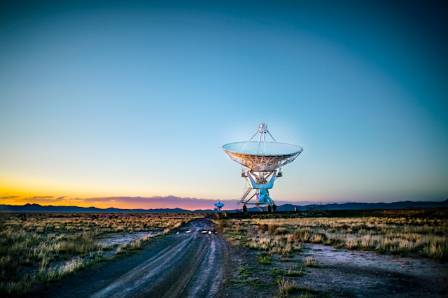
Radio telescopes perform a role similar to optical telescopes, but instead of collecting visible light, they gather radio-frequency emissions from space. These signals are concentrated, strengthened, and processed by specialized instruments for scientific analysis.
Astronomers rely on radio telescopes to investigate radio emissions from stars, galaxies, nebulae, black holes, and many other celestial objects. They can also transmit radio waves toward planets, moons, and asteroids, then analyze the reflected signals. These instruments are designed to detect wavelengths ranging from approximately 1 millimeter to more than 10 meters. By comparison, visible light wavelengths measure only a few hundred nanometers.
By the time radio signals from distant cosmic sources reach Earth, they are incredibly weak. In fact, the signal from a typical mobile phone is billions upon billions of times stronger than the radio waves detected from deep space.
Main Components of a Radio Telescope
Radio telescopes come in many configurations depending on the frequencies they are designed to observe. Despite their differences, all radio telescopes include an antenna system, a mounting structure, and sensitive receiving equipment.
Because radio waves are much longer than visible light waves and astronomical radio sources are extremely faint, radio telescopes often need enormous collecting areas and highly sensitive electronics. Unfortunately, these large antennas can also capture unwanted signals generated by modern technology, making radio-frequency interference a significant challenge.
The Antenna System
The simplest radio antenna is the metal dipole antenna, similar to the antennas commonly found on vehicles for receiving broadcast radio signals.
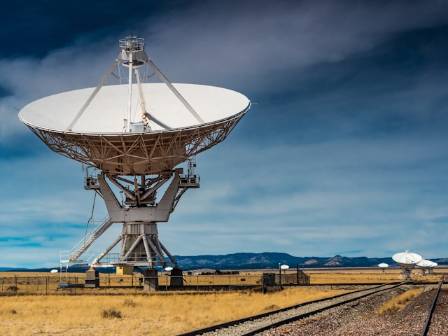
The most widely used and effective radio astronomy antenna is the parabolic dish. Its curved shape reflects incoming radio waves toward a single focal point. Since dishes can collect many wavelengths simultaneously, different receiver systems are used to isolate the desired frequencies for specific scientific studies.
Special waveguides known as feed horns are positioned to capture selected frequency ranges. Some of these feed horns are exceptionally large, with dimensions comparable to a pickup truck.
The narrow section of each feed horn is carefully engineered to correspond to a particular wavelength. When radio waves of the target frequency enter the horn, they resonate efficiently, allowing the horn to act as the primary detecting element. A cryogenically cooled receiver then captures the signal and forwards it to data-processing systems.
Feed Support Structures
Receivers may be mounted directly above the dish at its focal point, or additional mirrors can redirect the focused waves to a more convenient location.
When receivers are positioned above the reflector, signals travel through cables along the support framework to equipment located near the ground. This arrangement is known as a prime-focus design. However, limitations in weight, accessibility, and maintenance often restrict its practicality.
To maximize performance, many modern telescopes employ a secondary reflector called a subreflector. This mirror redirects the concentrated radio waves toward receiver systems located near the center of the dish. Some subreflectors can also move to select different feed horns or perform atmospheric measurements.
Importance of the Dish Surface
For telescopes observing very short radio wavelengths, such as millimeter waves, surface accuracy is extremely important. Even tiny imperfections can scatter incoming signals and reduce observational quality.
Environmental factors also influence performance. Wind, temperature fluctuations, and gravity can deform large antenna structures. As a result, facilities such as the Atacama Large Millimeter/submillimeter Array use relatively smaller dishes to maintain exceptional precision.
When observing longer wavelengths, such as centimeter waves, surface accuracy becomes less critical. Instruments like the Very Large Array and the Very Long Baseline Array can operate effectively with stronger, more rugged dish structures.
Telescope Mounting Systems
Some radio telescopes use equatorial mounts aligned with Earth's rotational axis. This design allows the telescope to track celestial objects by moving in synchronization with Earth's rotation.
Although effective, equatorial mounts become difficult to construct as telescope size increases because of the enormous weight that must remain balanced.
Most modern radio observatories instead use alt-azimuth mounts, which move in elevation and azimuth. Advanced computer systems continuously adjust these movements to follow astronomical targets accurately across the sky.
Processing Radio Astronomy Data
Early radio telescopes typically observed one frequency at a time. Modern systems can simultaneously monitor vast frequency ranges.
Powerful computers divide incoming signals into thousands of channels, each covering a specific frequency range. This capability transformed radio astronomy from a limited observational technique into a rich, multi-frequency science.
To detect extremely faint signals, telescopes often observe the same object for many hours. Computer systems repeatedly combine the incoming data, strengthening genuine astronomical signals while reducing random background noise.
Why Radio Telescope Arrays Are Necessary
The ability of a telescope to reveal fine detail, known as angular resolution, depends on the observing wavelength and the size of the antenna.
Because radio wavelengths are so long, even enormous single-dish telescopes provide limited resolution compared with optical telescopes. Building a single radio dish large enough to match optical resolution would be impractical.
The largest fully steerable radio telescope, the Green Bank Telescope, measures 100 meters across. Larger structures become increasingly difficult to build and control.
The solution was to combine multiple antennas into a coordinated array. This revolutionary concept earned its developers a Nobel Prize in Physics.
How Interferometry Works
When two radio telescopes observe the same object, the incoming waves reach each antenna at slightly different times because of their separation.
This timing difference creates a phase shift between the signals. By measuring and analyzing these shifts, scientists can combine observations from multiple antennas into a single, much larger virtual telescope.
As Earth rotates and the telescopes continue tracking the source, the viewing geometry changes. These changing perspectives provide additional information that improves image quality and resolution.
The greater the distance between antennas, the sharper the resulting observations become.
The Atacama Large Millimeter/submillimeter Array (ALMA)
The Atacama Large Millimeter/submillimeter Array combines 66 highly precise antennas using advanced supercomputing technology.
A central local oscillator distributes a synchronized timing signal through fiber-optic networks to every antenna. This reference signal acts like a conductor leading an orchestra, ensuring that all antennas operate together.
Each antenna processes its observations and sends the information to a central correlator. The correlator combines the signals and reconstructs highly detailed images of astronomical objects.
These systems perform calculations at extraordinary speeds, reaching quadrillions of operations every second.
Specialized software then transforms the processed data into scientific images and maps used by researchers worldwide.
Very Long Baseline Interferometry (VLBI)
The principle of interferometry becomes even more powerful when antennas are separated by thousands of kilometers.
This technique, known as Very Long Baseline Interferometry (VLBI), effectively creates a virtual telescope with a diameter equal to the distance between its antennas.
The Very Long Baseline Array is the world's largest dedicated VLBI network.
Because connecting such distant observatories with fiber-optic cables is impractical, each station uses an ultra-precise atomic clock. Hydrogen masers provide timing accuracy measured in billionths of a second.
Each telescope records its observations locally, along with exact timestamps. The data are then delivered to a central correlator facility, where powerful computers combine them into a unified observation.
This process enables astronomers to pinpoint cosmic radio sources with extraordinary precision, measure distances, and study some of the most distant and energetic phenomena in the universe.
The Lasting Importance of Radio Telescopes
Radio telescopes have opened a unique window into the cosmos, revealing phenomena invisible to optical instruments. From detecting molecular clouds and pulsars to imaging black holes and mapping distant galaxies, they continue to play a vital role in modern astronomy.
Through massive dishes, sophisticated receivers, advanced supercomputers, and global networks of antennas, radio astronomy allows scientists to explore the universe at wavelengths far beyond human vision, uncovering secrets hidden across billions of light-years of space.
यह भी पढ़ें
पृथ्वी का सबसे दूर स्थित अंतरिक्ष यान कौन सा है?
देवांश

डिजिटल कला की दुनिया में हलचल मचाने वाले 7 नवोन्मेषी कलाकार
दिव्य

महिलाओं के मौसमी बुना हुआ वस्त्रों के लिए आवश्यक मार्गदर्शिका
रानी रावत

Why Slugs and Snails Are Secretly the Ultimate Hidden Heroes of Your Garden
Chapman Samuel

स्केटबोर्ड के 7 प्रकार और उनके लाभ
जितेंद्र

कैसे बढ़ने और इनडोर कैक्टी की देखभाल
कविता