विशेष लेख
How 3D Printing Is Transforming Modern Industry
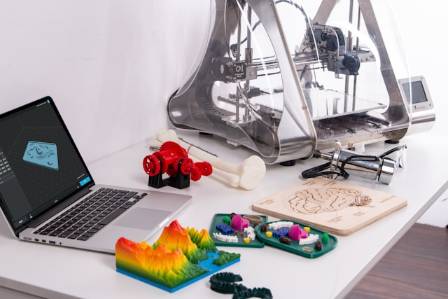
3D printing is a manufacturing process that creates physical objects by building them layer by layer from a digital model. Once mainly used for simple plastic prototypes, it has now expanded into a wide range of fields including aerospace, healthcare, automotive engineering, food innovation, and education. Its global market has grown rapidly, valued at about $23.41 billion in 2025 and projected to reach $136.76 billion by 2034, showing how quickly the technology is being adopted worldwide.
Evan Russell
लेखक
लेख परिचय
नीचे पूरा लेख पढ़ें।
अनुभाग
समाचार

3D printing is a manufacturing process that creates physical objects by building them layer by layer from a digital model. Once mainly used for simple plastic prototypes, it has now expanded into a wide range of fields including aerospace, healthcare, automotive engineering, food innovation, and education. Its global market has grown rapidly, valued at about $23.41 billion in 2025 and projected to reach $136.76 billion by 2034, showing how quickly the technology is being adopted worldwide.
Aerospace and Advanced Manufacturing
The aerospace industry is one of the most demanding environments for 3D printing, and it is already producing certified flight components. A major example is the GE9X jet engine, which incorporates seven additively manufactured parts that replaced more than 300 traditional components. These include turbine elements, fuel system components, and a unique debris-removal inducer that cannot be made using conventional methods. Together, these innovations contribute to a roughly 10% improvement in fuel efficiency compared to earlier engines.
Beyond weight reduction, 3D printing fundamentally changes how aerospace parts are designed and produced. Traditional manufacturing relies heavily on molds and tooling, which are expensive and slow to modify. Additive manufacturing removes this limitation by allowing engineers to directly produce updated designs from digital files. GE has applied this approach to multiple engines, including the Catalyst program, where hundreds of parts were consolidated into a small number of printed structures, dramatically reducing complexity and production time.
Healthcare: Implants, Prosthetics, and Bioprinting
In medicine, 3D printing addresses a key challenge: no two human bodies are identical. This has led to the development of patient-specific implants, surgical guides, splints, and anatomical models made from imaging data. Surgeons can now plan complex procedures using precise replicas of a patient’s anatomy, improving accuracy and outcomes.
The technology is also widely used in prosthetics and orthotics. By scanning a patient’s body, clinicians can design and manufacture devices that fit perfectly, improving comfort and performance. Institutions such as Thomas Jefferson University’s Health Design Lab use this approach to turn medical scans into physical models that assist in surgical planning.
A more experimental area is bioprinting, which involves printing tissues using living cells. The long-term goal is to eliminate the need for donor tissue and reduce secondary surgical damage. While simple tissues may become clinically viable within the next couple of decades, fully functional organs remain a longer-term objective. At present, bioprinting is mainly used for research and medical testing rather than routine treatment.
Automotive Industry and Spare Parts Production
The automotive sector benefits from 3D printing in solving a persistent issue: the scarcity of replacement parts for older vehicles. When production lines shut down, molds are discarded and suppliers disappear, making traditional manufacturing of spare parts expensive and inefficient.
With additive manufacturing, these parts can be digitally recreated using CAD files or scans and produced on demand without tooling. Components such as brackets, housings, and suspension elements can be printed in strong metals like stainless steel or Inconel. Each part is digitally recorded, ensuring consistency and traceability for industrial use.
Beyond replacement parts, car manufacturers also use 3D printing for tooling applications. Assembly fixtures, welding jigs, and inspection tools that once required long development cycles can now be produced quickly. This significantly shortens engineering timelines and allows rapid design iteration.
Food Innovation and Personalized Nutrition
3D food printing is an emerging field that enables the creation of food with customized shapes, textures, flavors, and nutritional profiles. One of its most promising applications is in plant-based meat alternatives, where layered printing techniques improve texture realism compared to conventional processing.
The technology also opens the door to personalized nutrition. In theory, meals could be tailored to an individual’s dietary requirements by adjusting protein, fat, vitamins, and minerals at the point of production. This has potential applications in healthcare settings, elderly care, and sports nutrition.
Education and Hands-On Learning
Educational institutions increasingly use 3D printing to teach engineering, design, and problem-solving skills. Students can move through the full development cycle—designing in CAD software, printing prototypes, testing functionality, and refining designs based on real-world feedback.
This process mirrors professional product development and helps students build practical skills in modeling, materials understanding, and iterative design. Universities such as Duke have even used 3D scanning and printing to create customized protective equipment, demonstrating how academic projects can translate into real-world applications.
Common 3D Printing Materials
The material used in 3D printing plays a major role in determining the strength, flexibility, and precision of the final product.
PLA is the easiest material for beginners. It prints at low temperatures and produces accurate shapes, but it is relatively brittle and not suited for high-heat or industrial applications.
ABS offers greater durability and resistance, making it common in industrial and automotive contexts. However, it can warp during printing and often requires controlled heating conditions.
Resin provides extremely high detail and smooth finishes. It is ideal for precision applications such as dental models, jewelry, and miniatures, though it is less suited for heavy mechanical loads.
Industrial-grade systems go even further, using metal powders, carbon-fiber composites, and even concrete, enabling the production of functional parts for aerospace and construction.
Why 3D Printing Is Replacing Traditional Manufacturing
The main advantage of 3D printing is that complexity does not significantly increase cost. Traditional methods like machining waste material by cutting away excess, while casting requires expensive molds and long setup times. In contrast, additive manufacturing builds only what is needed, directly from a digital file.
This makes it especially valuable for custom parts, small production runs, and rapid prototyping. Designs can be modified and reprinted within hours, allowing companies to test multiple iterations quickly. Hospitals can produce patient-specific tools, and manufacturers can recreate obsolete parts without maintaining physical inventories.
As a result, 3D printing is steadily reshaping how industries design, produce, and deliver physical objects.
यह भी पढ़ें

पृथ्वी का सबसे दूर स्थित अंतरिक्ष यान कौन सा है?
देवांश

ऑटोमोबाइल से जुड़े रोचक तथ्य: कारों की दुनिया में एक गहन पड़ताल
रमेश माहेश्वरी

समुद्री दृश्यों की कला में महारत हासिल करने के लिए मार्गदर्शिका: एक क्रमबद्ध ऐक्रेलिक ट्यूटोरियल
हरप्रीत कौर

Effortless French Macarons: A Foolproof Guide
Maddison

सुपरकंप्यूटर सिमुलेशन संकेत देते हैं कि 100 अभी तक अनखोजी आकाशगंगाएँ मिल्की वे के चारों ओर परिक्रमा कर रही हो सकती हैं।
तान्या

Most Important Prehistoric Cave Paintings in the World
Caspian Vale