विशेष लेख
Black-winged kite: a ghost at dusk
A few weeks ago, I had the great fortune to meet a stunning black-winged kite in the Aznalcázar Marshes. This elegant bird is one of my three favorite species, and it came close enough for me to capture a wonderful series of photographs. After returning home and viewing the images on my computer, I was so impressed by its beauty that I felt compelled to share this remarkable bird with others.
Lauren Mitchell
लेखक
लेख परिचय
नीचे पूरा लेख पढ़ें।
अनुभाग
समाचार
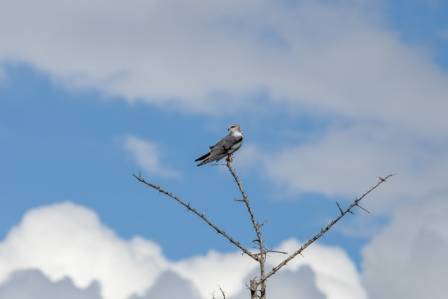
A few weeks ago, I had the great fortune to meet a stunning black-winged kite in the Aznalcázar Marshes. This elegant bird is one of my three favorite species, and it came close enough for me to capture a wonderful series of photographs. After returning home and viewing the images on my computer, I was so impressed by its beauty that I felt compelled to share this remarkable bird with others.
The black-winged kite is a small but graceful bird of prey, similar in size to a common kestrel. It has striking ruby-red eyes, a white head, bluish-gray feathers, and bright yellow legs. Its broad, pointed wings resemble those of a peregrine falcon, while its hunting style combines features of several raptors. Like a kestrel, it can hover in place while searching for prey, and like a harrier, it can glide with raised wings. Its plumage is mainly a combination of gray, white, and black, although unlike harriers, it rarely spends time on the ground.
A Bird With Qualities of Both Eagle and Owl
The genus Elanus contains four species that share very similar body shapes and feather patterns. For many years, they were considered a single widespread super-species with different regional forms. The black-winged kite is generally a quiet bird, and its calls are rarely heard except during breeding displays.
In tropical regions, these birds behave somewhat like nomadic owls from northern areas. They may travel long distances and begin breeding when populations of their preferred prey increase dramatically. Their activity often occurs during twilight or at night.
The black-winged kite also possesses several physical traits that resemble owls, likely because of evolutionary adaptation. Its feathers have soft structures that allow nearly silent flight, its toes are arranged in a zygodactyl pattern with two facing forward and two backward, and its large forward-facing eyes provide excellent binocular vision. It also has long facial bristles and short, strong legs. Like owls, it has a wide mouth that allows it to swallow prey whole.
Recent research suggests that Elanus may represent one of the oldest groups within the Accipitridae family, and its previous classification as a typical kite was likely incorrect.
A New Arrival That Enriched Iberian Wildlife
The black-winged kite reached the Iberian Peninsula from African savannas during the second half of the 20th century. The open forests and agricultural landscapes of the region provided ideal conditions for this species to establish itself and expand.
Changes in land management, including forest clearing and the development of modern farming and livestock practices, transformed many areas. In Extremadura, large oak forests were reduced and traditional grazing lands were converted into cereal fields, creating suitable habitats for black-winged kites arriving from Portugal. This led to the formation of important breeding colonies.
Since the first confirmed breeding record in Spain in 1970, the subspecies Elanus caeruleus caeruleus has continued extending its range across the southwestern Iberian Peninsula. It has even expanded beyond the Pyrenees into France’s Landes region. Today, it is considered one of the most widespread raptors in the world, living across large areas of sub-Saharan Africa, tropical Asia, and increasingly throughout Europe.
The Ideal Adaptable Predator
The black-winged kite is a highly adaptable raptor that can survive in many open environments with scattered trees, similar to the landscapes where it evolved in Africa. It has successfully taken advantage of environmental changes caused by human activity.
Its range covers the western Palearctic, parts of Asia including Arabia, Pakistan, the Philippines, and Indonesia, as well as sub-Saharan Africa. These birds can live in habitats ranging from sea level to mountainous regions reaching around 3,000 meters in elevation.
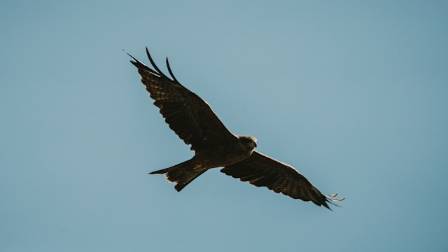
The species truly represents an efficient and versatile hunter. Its diet includes small mammals, birds, reptiles, and insects. When searching for food, it often remains suspended in the air while observing the ground below. Once it identifies prey, it slowly descends with slightly raised wings before suddenly folding them and diving toward the target, much like a kestrel.
The black-winged kite is especially active around sunrise and sunset, making these periods the best times to observe it. Its pale feathers provide excellent camouflage, particularly under cloudy skies. Quiet and difficult to notice, this beautiful raptor appears almost ghost-like against the landscape, with its intense red eyes leaving a lasting impression.
Remarkable Breeding Abilities
Black-winged kites usually build their nests in low trees that overlook large open hunting areas, often covering around five square kilometers of grassland or farmland. Both males and females have similar appearances and work together to construct a simple nest made from dry branches.
The pair shares responsibility for incubating eggs and feeding their young. A typical clutch produces three or four chicks. Once the young birds become capable of flying, the female usually leaves the nest area, while the male continues caring for the juveniles, sometimes for several additional months.
Young black-winged kites have different markings from adults. Their crowns and breasts often show rusty tones, their backs are darker gray with pale edges on the shoulder feathers, and their wings and tail feathers have more noticeable brown and gray coloring.
When food supplies are abundant, these birds may successfully raise more than one brood in a year. During winter, they often leave their breeding territories and move to areas with greater food availability, sometimes traveling hundreds of kilometers.
Expansion Around Doñana
In the Doñana region, black-winged kite populations are clearly increasing. Although they remain uncommon inside the National Park itself, they are becoming more frequent in nearby agricultural landscapes and dehesa habitats.
Areas such as the grasslands around Cortijo de los Mimbrales, marsh edges near the Matasgordas Cork Oak Forest, the transformed wetlands of Aznalcázar during winter, the Dehesa de Pilas, surrounding farmland, and especially the newly restored open forests along the Guadiamar River Green Corridor have attracted growing numbers of these elegant raptors.
The continued expansion of the black-winged kite demonstrates its remarkable ability to adapt, survive, and bring new beauty to Iberian landscapes.
यह भी पढ़ें

रोलर स्केटिंग आपके लिए एकदम सही गतिविधि क्यों है, इसके 10 कारण
सौरभ

बीज से अंकुर तक: अंकुरित करने के लिए एक शुरुआती मार्गदर्शिका, लुईस कोहेन-सिल्वर, पीएच.डी., वी.एल.सी.ई. द्वारा
देव

The Formula Behind Artistic Creativity
Bob

The 10 Best Supercars For 2026
Evander Cole
एक पालतू पक्षी के मालिक होने का लाभ
इशिता

2025 में दुनिया की शीर्ष 10 सबसे तेज़ कारें
राधा