विशेष लेख
Snow Place Like Home: Winter Landscapes in Prints
Winter landscapes have always held a lasting fascination for artists across different eras, drawing them in with their silence, subtle power, and emotional depth. In art history, winter is far more than a seasonal backdrop—it becomes a symbol and a lens through which both the outer world and inner human states are explored.
Eleanor Whitmore
लेखक
लेख परिचय
नीचे पूरा लेख पढ़ें।
अनुभाग
समाचार
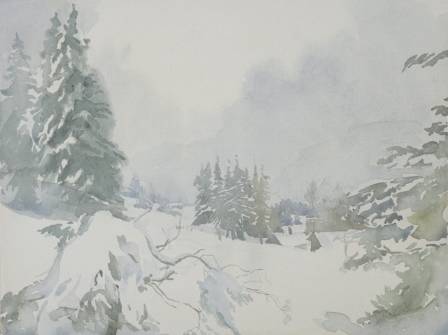
Winter landscapes have always held a lasting fascination for artists across different eras, drawing them in with their silence, subtle power, and emotional depth. In art history, winter is far more than a seasonal backdrop—it becomes a symbol and a lens through which both the outer world and inner human states are explored.
These snow-covered scenes often encourage reflection on solitude, endurance, and the ongoing cycles of change. For contemporary and modern artists in particular, winter provides a rich visual and conceptual language for expressing both personal introspection and shared human experience.Artists such as David Hockney, Julian Opie, and Peter Doig use the stillness of winter to consider time, vulnerability, and the quiet strength that can be found in moments of isolation and contemplation.
1. Snow — David Hockney (1973)
Hockney’s Snow (1973), part of The Weather Series, captures winter in a restrained and elegant visual form. The work evokes the quiet atmosphere of a snow-covered landscape, using simplicity and structure to create a deeply immersive experience.
Influenced strongly by Japanese Ukiyo-e masters such as Hokusai and Hiroshige, Hockney adopts their emphasis on clarity, balance, and refined composition. Soft horizontal transitions in tone suggest depth and distance, giving the impression of a vast, frozen environment stretching beyond the frame.
The surface treatment makes the scene feel almost physical, as though the silence of snowfall could be felt. At the same time, the work blends traditional aesthetic ideas with modern print techniques, merging historical influence with contemporary artistic thinking. Within The Weather Series, Snow stands out as a poetic reflection on fleeting natural moments turned into lasting visual calm.
2. Winter 74 — Julian Opie (2012)
Winter 74 (2012) is part of Julian Opie’s larger Winter project, which consists of 75 sequential images documenting a circular walk through the French countryside on a misty winter day. Rather than presenting a single frozen moment, the series functions like a visual journal unfolding across time.
Each image records subtle shifts in scenery and mood, simulating the sensation of movement through space. The viewer experiences the rhythm of walking, noticing gradual changes in light, terrain, and atmosphere.
Opie uses a reduced palette dominated by muted greens, browns, and greys, occasionally punctuated by white snow or pale winter light. His simplified graphic forms strip the landscape to its essentials, yet when viewed together, the sequence creates a dynamic and almost animated impression. The work connects digital precision with natural repetition, turning a winter walk into a structured meditation on time and perception.
3. Winter in Broughton & Going to the Match — L. S. Lowry (1969, 1972)
L. S. Lowry’s Winter in Broughton and Going to the Match demonstrate his distinctive ability to transform ordinary urban life into emotionally resonant seasonal scenes.
In Winter in Broughton, a snow-covered residential area is shown with rows of terraced houses standing rigid in the cold. Bare trees rise like silhouettes, reinforcing the wintry setting. Small figures move through the streets, adding rhythm and life. Lowry’s intentionally simplified style avoids detailed realism, instead creating a memory-like atmosphere that feels slightly detached yet emotionally familiar.
Similarly, Going to the Match depicts crowds walking toward a football stadium beneath a grey winter sky. Despite the cold and bleak weather, the people move with purpose, suggesting shared ritual and community spirit. Together, these works highlight winter not only as a harsh environment but also as a season that strengthens social bonds and collective resilience.
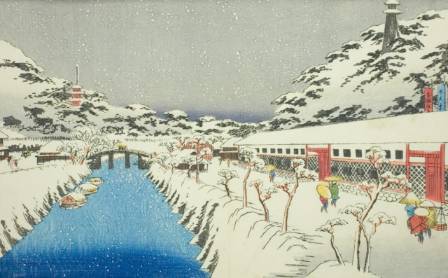
4. Zermatt D1 — Peter Doig (2022)
Peter Doig’s Zermatt D1 series explores the dramatic Alpine environment of Zermatt in Switzerland, combining expressive painting traditions with modern printmaking techniques.
The works depict vast snow-covered mountain ranges inhabited by skiers moving across icy terrain. These figures appear small against the overwhelming scale of nature, emphasizing human fragility within a powerful landscape.
Different compositions within the series suggest varied emotional states—moments of solitude, tension, or quiet focus. Light and shadow are layered to create depth and motion, giving the impression of fleeting instants suspended in time.
Doig’s use of high-precision giclée printing allows subtle variations in texture and tone to be preserved, enhancing the realism of snow, light, and movement while maintaining a dreamlike atmosphere.
5. Snow Pines — Helen Frankenthaler (2004)
Helen Frankenthaler’s Snow Pines reflects her Abstract Expressionist approach, transforming the idea of a snowy forest into a fluid exploration of color and emotion rather than literal depiction.
Using her signature soak-stain technique, she allows pigments to spread and merge organically across the canvas. The result is a layered, flowing composition that suggests shifting light, drifting snow, and natural atmosphere without directly illustrating them.
Instead of fixed forms, the painting offers impressions—transient sensations of winter rather than defined scenery. The overlapping hues evoke both fragility and calm, capturing the seasonal mood in an abstract, atmospheric language.
Conclusion
Winter landscapes in art extend far beyond visual representation of a season. They become reflections on time, endurance, and the human condition. Whether through structured landscapes, stylized urban scenes, expressive prints, or abstract color fields, artists use winter to explore stillness and transformation.
Across styles and centuries, these works remind us that even in the coldest and quietest moments, there is depth, resilience, and unexpected beauty.
यह भी पढ़ें
Global Leaders in Confectionery: Which Nation Produces the Best Chocolate?
Evelyn Grace Richardson
स्केटबोर्ड के 7 प्रकार और उनके लाभ
जितेंद्र
10 शानदार कोस्टल क्लिफ्स
तन्वी
जलमग्नता में महारत हासिल करना: जलमग्न कला के लिए एक व्यापक मार्गदर्शिका
सूरज मण्डोवाल

6 सरल ग्रीक योगर्ट ब्रेकफास्ट बाउल
नीरज

10 कारण क्यों बिल्लियाँ महान पालतू जानवर बनाते हैं
गीता