विशेष लेख
The Taj Mahal Story
Who could imagine that a love eternal enough to inspire a story of infinite devotion could arise in a barren land and blossom into a gift to the world—a poem carved in marble, the Taj Mahal?
Thoren Grey
लेखक
लेख परिचय
नीचे पूरा लेख पढ़ें।
अनुभाग
समाचार
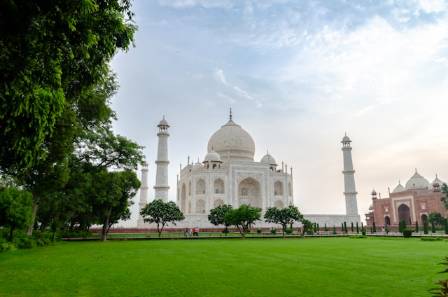
Who could imagine that a love eternal enough to inspire a story of infinite devotion could arise in a barren land and blossom into a gift to the world—a poem carved in marble, the Taj Mahal?
No painting or photograph, no film or canvas, can truly capture the imagination, the legend, the poetry, or the romance encapsulated in what Rabindranath Tagore famously described as “a teardrop on the cheek of time.”
The Taj Mahal, a masterpiece in gleaming white marble, stands unmatched in splendor, reflecting the opulence of an era gone by. This breathtaking monument, created by Mughal Emperor Shah Jahan as a tribute to his beloved wife Mumtaz Mahal, is a testament to his profound love. Its beauty is amplified by the intricate use of precious and semi-precious stones, creating a romance immortalized in stone.
Agra: The City of the Taj
Located in Uttar Pradesh, a land steeped in cultural richness and political history, Agra—the home of the Taj Mahal—once served as the Mughal Empire’s capital from the 16th to early 18th centuries. Its proximity to New Delhi makes it easily accessible for tourists who come from across the globe to marvel at India’s most iconic architectural wonder.
The Taj Mahal, meaning “Crown Palace,” is widely regarded as the world’s most pristine and beautifully designed tomb. Sir Edwin Arnold, an English poet, famously described it as “not merely a piece of architecture, but the proud passion of an emperor’s love sculpted in living stone.”
A Monument of Love and Legacy
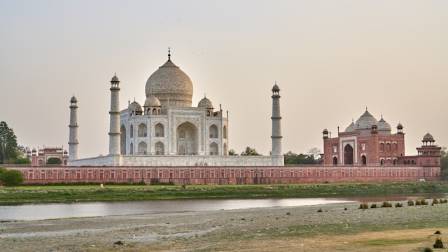
The Taj sits majestically on the banks of the Yamuna River, which once helped defend the nearby Agra Fort, the seat of Mughal power until the capital shifted to Delhi in 1637. Shah Jahan commissioned the Taj in 1631 to honor his third and most cherished wife, Mumtaz Mahal, a Persian Muslim princess who died during childbirth on a military campaign. Her death left Shah Jahan so grief-stricken that his hair and beard reportedly turned white within months.
Before her passing, Mumtaz extracted four promises from Shah Jahan: to build the Taj, to remarry, to care for their children, and to visit her tomb annually. Unfortunately, due to poor health and his eventual house arrest by his son Aurangzeb, the emperor could not fulfill the last promise.
Architectural Grandeur
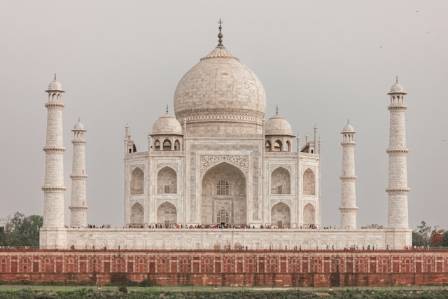
The Taj Mahal rests on a red sandstone base with a grand white marble terrace above, crowned by its iconic dome and flanked by four slender minarets. Inside the dome lies the exquisitely inlaid cenotaph of Mumtaz Mahal. The craftsmanship is so remarkable that many have said the Taj was “designed by giants and completed by jewelers.” The only deviation from symmetry is Shah Jahan’s cenotaph, positioned slightly to the side, added later.
Legend says that during Shah Jahan’s years of illness and imprisonment, he would gaze at the Taj from his bed through a diamond set into the wall at a specific angle, keeping the vision of his beloved alive in his mind.
A Symbol of Eternal Love
The Taj Mahal represents more than beauty; it symbolizes undying love. Its rectangular base allows multiple perspectives, mirroring the way one appreciates a beloved. The main gate acts as a veil, gently lifted to reveal the grandeur within, similar to the delicate unveiling of a bride in Indian tradition.
The marble dome and reflective river backdrop create a magical interplay of light and color, shifting through pink, white, and golden hues with the passage of time and the phases of the moon. Inlaid semi-precious stones catch moonlight, making the monument sparkle like a jewel.
Myths and Legends
The Taj is steeped in myths, the most famous being the “Black Taj,” a dark marble twin that Shah Jahan allegedly planned to build across the Yamuna River. Work reportedly stopped after Aurangzeb, his son, imprisoned the emperor and prevented its completion. While historians debate the truth of this tale, it has become an enduring part of the Taj’s lore.
Beyond Love: Power and Spirituality
While the Taj Mahal is an eternal emblem of romance, it also conveys messages of harmony, spirituality, and solemnity. Shah Jahan intended it to represent purity, balance, and universal love. The monument’s grandeur, symmetry, and meticulous craftsmanship reflect the Mughal Empire’s cultural and political sophistication.
The Taj is not just a tomb; it is a testament to the universal ideals of love and peace, a reminder of devotion transcending time, and a celebration of beauty and artistry.
Come witness it for yourself—the Taj Mahal continues to reveal its magic, captivating every beholder with the eternal story of love immortalized in marble.
यह भी पढ़ें

The 10 Best Supercars For 2026
Evander Cole

Green Energy Sites Protect Threatened Plant Life
Joshua Ryan Garcia

Top Supercars to Purchase in 2026
Ethan

The World’s Most Followed Sports
Sophia Bell

प्रत्येक गतिविधि के लिए आदर्श महिला खेल परिधान चुनने के सिद्धांत
ओम प्रकाश चावड़ा

6 सरल ग्रीक योगर्ट ब्रेकफास्ट बाउल
नीरज