विशेष लेख
Comprehensive Guide to the Ring-Tailed Lemur
The ring-tailed lemur is a distinctive primate easily recognized by its long, alternating black and white banded tail. Scientifically classified as Lemur catta, its name is derived from the Latin words for "ghost" and "cat." These animals belong to the family Lemuridae and are part of the diverse primate order. They are medium-sized mammals characterized by their social complexity and unique physical adaptations that set them apart from other lemur species.
Jacob Lawson
लेखक
लेख परिचय
नीचे पूरा लेख पढ़ें।
अनुभाग
समाचार
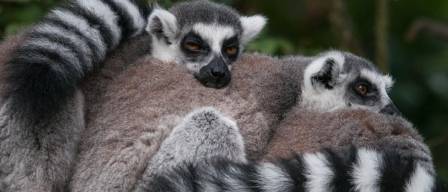
The ring-tailed lemur is a distinctive primate easily recognized by its long, alternating black and white banded tail. Scientifically classified as Lemur catta, its name is derived from the Latin words for "ghost" and "cat." These animals belong to the family Lemuridae and are part of the diverse primate order. They are medium-sized mammals characterized by their social complexity and unique physical adaptations that set them apart from other lemur species.
Physical Characteristics and Biological Data
Adult ring-tailed lemurs possess a tail that can reach nearly 600 mm (approximately 23.6 inches) in length, which is longer than their actual body. In terms of mass, males and females are very similar, typically weighing around 2.7 kg (roughly 95 ounces). Males are equipped with specialized scent glands on their wrists, featuring a sharp, fingernail-like spur used for marking territory. Their diet is primarily herbivorous, consisting of 70% fruit, 25% foliage, and a small percentage of flowers.
Reproduction usually occurs during a specific mating season between August and September. After a gestation period of roughly 134 to 138 days, females typically give birth to a single infant, though twins are common when resources are abundant. These primates reach sexual maturity between 21 and 30 months of age and can live for an average of 27 years.
Habitat and Distribution
This species is endemic to the island of Madagascar, where it occupies a variety of environments including dry forests, scrublands, gallery forests, and spiny deserts. Among all lemurs on the island, the ring-tailed variety is the most terrestrial, meaning it spends a significant portion of its time on the ground rather than in the canopy. They are also known to venture further into the interior highlands of Madagascar than any of their relatives, showcasing a remarkable ability to adapt to different elevations and climates.
Social Behavior and Unique Traits
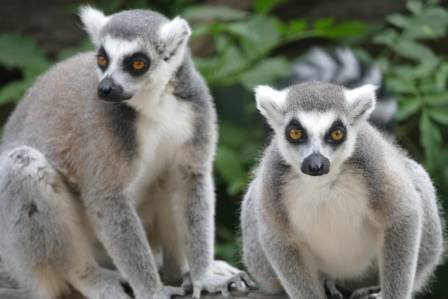
The social structure of ring-tailed lemurs is notably female-dominated; in any conflict over resources or territory, the females always emerge victorious. Interestingly, unlike many other primates with fixed social hierarchies, young lemurs must "grapple" or compete to establish their dominance from a very early age. Males engage in a unique ritual known as "stink fighting," where they rub their tails against the scent glands on their wrists and wave them at rivals to assert authority without physical combat.
Newborn care is also specialized. A mother will initially carry her offspring in her mouth until the infant develops enough strength to cling to the fur on her belly or back. To mark their territory, males use the spurs on their forearms to scar tree branches, leaving a long-lasting olfactory signature that warns other groups of their presence.
Conservation Status and Ecological Importance
Ring-tailed lemurs serve a vital ecological role within Madagascar's unique biodiversity. However, their survival is currently under severe threat. The United States Fish and Wildlife Service classifies them as Endangered, and they are listed under CITES Appendix I. Their populations are in sharp decline primarily due to habitat loss driven by the logging industry, the expansion of agricultural plantations, and "slash and burn" farming techniques.
Because these primates rely heavily on primary, undisturbed vegetation, they are unable to thrive in secondary forests or heavily altered landscapes. The loss of the ring-tailed lemur would mean the disappearance of a key seed disperser and a significant representative of Madagascar’s evolutionary history. Protecting the remaining primary forests is essential for the continued existence of this iconic species.
यह भी पढ़ें

The four largest interchanges in the United States
Jane

एफिल टॉवर के बारे में 5 रोचक तथ्य और राज
चिराग

The Formula Behind Artistic Creativity
Bob

हर अवसर के लिए एंकल बूट्स को स्टाइल करने की संपूर्ण गाइड
रानी बैरवा
9 Fascinating Facts About Blue-Footed Boobies
Hannah Price

फूलों की सजावट के 15 बेहतरीन आइडिया
सत्य